GuideBristol stool scale
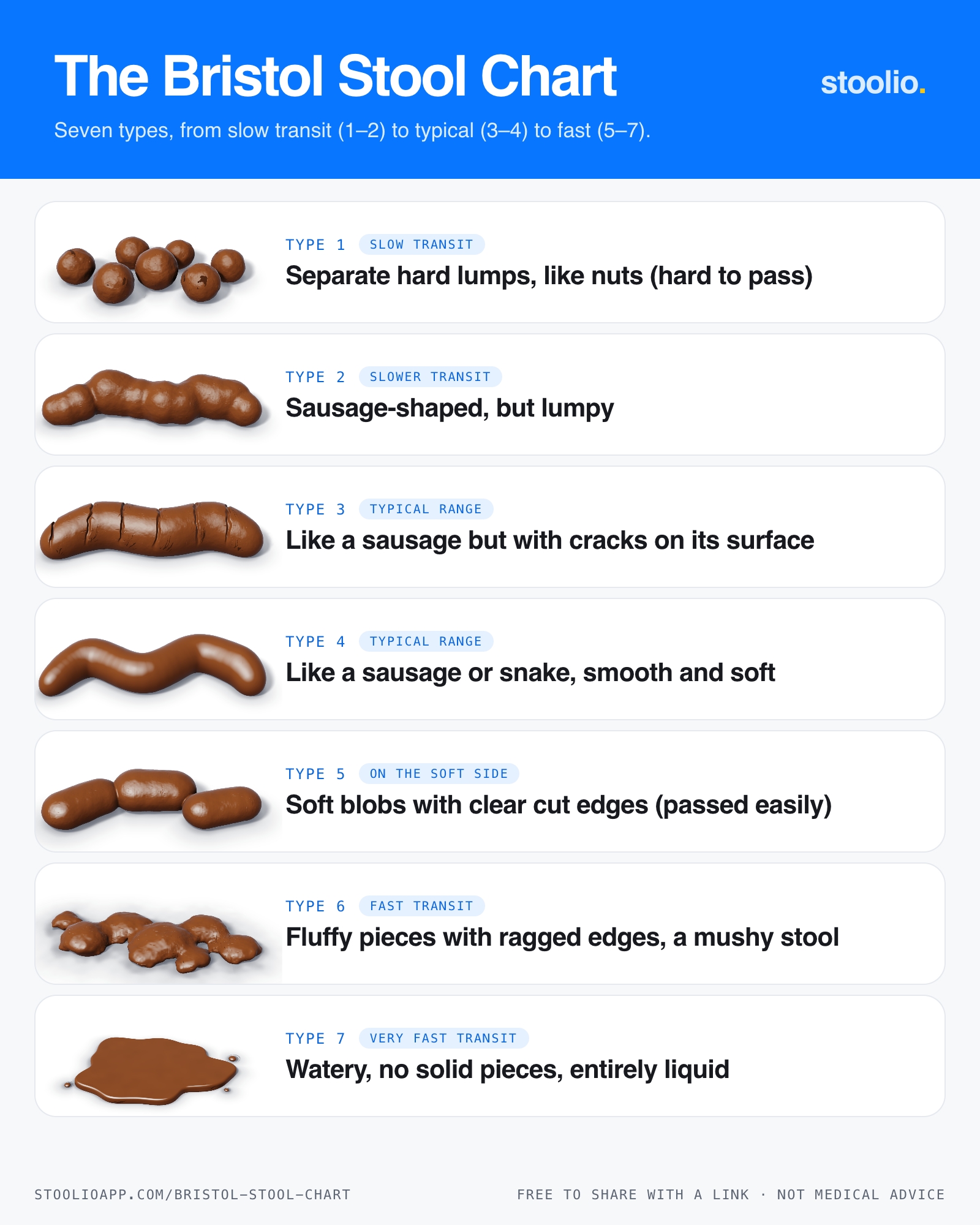
The Bristol Stool Chart
Seven shapes, from hard pellets to entirely liquid, that tell you how fast things moved through you. Tap a type to see what it usually means.

Type 1 Slow transit
Separate hard lumps, like nuts (hard to pass)
- Usually associated with
- Slow transit and hard, dry stool that can be difficult to pass.
- Things worth considering
- Fiber
- Fluids
- Movement
- Routine
Not sure what type yours is? Stoolio estimates your Bristol type automatically.
Scan yours ↗
Type 2 Slower transit
Sausage-shaped, but lumpy
- Usually associated with
- Slower-than-typical transit and firm, drier stool.
- Things worth considering
- Fiber
- Fluids
- Movement
Not sure what type yours is? Stoolio estimates your Bristol type automatically.
Scan yours ↗
Type 3 Typical range
Like a sausage but with cracks on its surface
- Usually associated with
- The typical range, on the slightly firmer side.
- Things worth considering
- Hydration
- Fiber
- Activity
Not sure what type yours is? Stoolio estimates your Bristol type automatically.
Scan yours ↗
Type 4 Typical range
Like a sausage or snake, smooth and soft
- Usually associated with
- The typical range: formed, soft and easy to pass.
- Things worth considering
- Consistency
- Fiber
- Routine
Not sure what type yours is? Stoolio estimates your Bristol type automatically.
Scan yours ↗
Type 5 On the soft side
Soft blobs with clear cut edges (passed easily)
- Usually associated with
- Slightly faster transit and a softer stool. Sources differ on whether it counts as typical.
- Things worth considering
- Soluble fiber
- Caffeine
- Meal size
Not sure what type yours is? Stoolio estimates your Bristol type automatically.
Scan yours ↗
Type 6 Fast transit
Fluffy pieces with ragged edges, a mushy stool
- Usually associated with
- Fast transit: stool moved through before much water could be absorbed.
- Things worth considering
- Fluids
- Recent foods
- Stress
Not sure what type yours is? Stoolio estimates your Bristol type automatically.
Scan yours ↗
Type 7 Very fast transit
Watery, no solid pieces, entirely liquid
- Usually associated with
- Very fast transit: liquid stool, with fluid loss to replace.
- Things worth considering
- Fluids
- Electrolytes
- Rest
Not sure what type yours is? Stoolio estimates your Bristol type automatically.
Scan yours ↗The Bristol stool chart sorts poop into seven types by shape and texture, from Type 1 (separate hard lumps) to Type 7 (entirely liquid). Types 1 and 2 usually mean stool moved slowly and dried out on the way. Types 3 and 4 are the range clinical sources describe as typical. Types 5 to 7 mean it moved faster and kept more of its water. It is the standard way to describe stool, in clinics and in research.
The quick way to find your type: Stoolio estimates your Bristol type from one photo, along with a Stoolio Score and 12 visual readings, and keeps the record so your pattern shows up over time. Your first three scans are free.
What is the Bristol stool chart?
The chart was created in 1997 by Dr. Stephen Lewis and Dr. Ken Heaton at the Bristol Royal Infirmary in England, which is where the name comes from. Their study of 66 volunteers found that the shape of stool tracked how long food took to pass through the gut better than how often people went did. That made the chart useful: a simple picture-matching exercise stood in for a transit test that normally needs a lab.
Today the seven types are the shared vocabulary of digestive health. The Rome IV criteria, which gastroenterologists use to classify conditions such as irritable bowel syndrome, are written in Bristol types, and so are countless stool diaries and research studies. The descriptions below are the chart's own wording.
| Type | What it looks like | Usually associated with |
|---|---|---|
| Type 1 | Separate hard lumps, like nuts (hard to pass) | Slow transit, hard and dry |
| Type 2 | Sausage-shaped, but lumpy | Slower transit, firm and dry |
| Type 3 | Like a sausage but with cracks on its surface | Typical range, slightly firm |
| Type 4 | Like a sausage or snake, smooth and soft | Typical range |
| Type 5 | Soft blobs with clear cut edges (passed easily) | Softer; sources differ on where it belongs |
| Type 6 | Fluffy pieces with ragged edges, a mushy stool | Fast transit, loose |
| Type 7 | Watery, no solid pieces, entirely liquid | Very fast transit, liquid |
How to read the chart
Think of the scale as a dial for speed and water. The colon's job is to absorb water from what passes through it, so the longer stool stays, the drier and harder it gets. That gives the chart three zones:
- Types 1 and 2, the slow side. Hard, dry, sometimes difficult to pass. Cleveland Clinic says these types suggest constipation, and the Rome Foundation's own card labels them constipated stool.
- Types 3 and 4, the typical range. Formed, soft enough, easy to pass. Clinical reviews describe these two types as normal stools, and Cleveland Clinic calls them the most ideal. Neither is "better" than the other.
- Types 5 to 7, the fast side. Stool moved through quickly and did not lose as much water. Types 6 and 7 are what the Rome criteria count as loose stool.
Type 5 is the one sources disagree on. Cleveland Clinic groups it with Types 6 and 7; a 2016 validation study counted Types 3 to 5 as normal; a clinical review says Type 5 counts as loose only "to some degree." In practice, an occasional Type 5 after an ordinary day is common. A steady run of it is worth noticing.
Does your type really show your transit time?
Roughly, and best at the extremes. A review in the Journal of Clinical Medicine describes stool form as a rough stand-in for colon transit when stool sits at either end of the scale. In a multicenter study of adults with constipation, a type below 3 picked out slow whole-gut transit with 85% sensitivity and 82% specificity. The same study found no such link in healthy adults, while an earlier study of healthy volunteers on controlled diets did find hard stool tied to slow colon transit. So the honest summary is that the chart reflects what happened in your colon, and it is a signal, not a stopwatch.
It is a better signal than frequency, though. The same research that validated the chart found that how often someone goes is a poor guide to how fast things are moving. Shape carries more information than count.
What counts as normal?
Mostly Types 3 and 4, with regular exceptions. In a Swedish study of healthy adults who logged every bowel movement, about 77% of stools were normal in consistency, 12% were hard and 10% were loose. Cleveland Clinic puts it simply: a hard poop or a mushy poop now and then is normal.
Frequency varies widely too. In the same study, 98% of healthy adults went somewhere between three times a day and three times a week, and MedlinePlus notes that you do not need a bowel movement every day. What matters most is your own usual pattern, which is why one poop tells you much less than a week of them. A small 2021 study of healthy adults found that most of the variation in stool consistency happened within the same person from day to day, not between people. Our Learn article on why poop changes every day goes deeper.
What moves your type?
Stool form responds to ordinary inputs. The ones with real evidence behind them:
- Fiber, and which kind. For chronic constipation, the joint 2023 guideline from the American Gastroenterological Association and the American College of Gastroenterology found that among fiber supplements only psyllium appears to be effective. Psyllium can also firm up loose stool. Wheat bran improves bowel function in healthy people but can make diarrhea worse. Add fiber slowly: NIDDK and MedlinePlus both note that a sudden increase can bring bloating and gas.
- Fluids, when you are short on them. In a trial of constipated adults already eating a high-fiber diet, drinking 1.5 to 2 liters of water a day improved the fiber's effect. In healthy volunteers, extra water mostly produced extra urine. Water matters most when you are under-hydrated or adding fiber.
- Movement. A 2019 review of nine trials found exercise helped constipation symptoms, though the trials had a high risk of bias. NIDDK says regular physical activity may help.
- Coffee. About 29% of people in one study said coffee brought on the urge to go, and decaf worked too, so caffeine is not the whole story.
- Sugar alcohols. Sorbitol, mannitol and xylitol in sugar-free foods can cause diarrhea in some people (NIDDK). US rules require a "laxative effect" warning on foods likely to supply 50 grams of sorbitol a day.
- Medicines. Opioid pain medicines, iron supplements, antacids with aluminum or calcium, and some antidepressants are linked to constipation; antibiotics and antacids with magnesium to loose stool. Do not stop a medicine without talking to a clinician.
- Routine, travel and stress. NIDDK lists travel, changes in what you eat and ignoring the urge to go; the NHS adds stress and anxiety.
- The menstrual cycle. In one study of women taking oral contraceptives, stools were looser and more frequent on the first day of bleeding. In another, 28% reported diarrhea during their period.
Why matching your own poop is harder than it looks
Matching a stool to a chart sounds easy, and mostly it is. In a 2016 validation study, volunteers matched stool models to the right type about four times in five. The mistakes were not random, though: they clustered at the borders between Types 2 and 3 and between Types 5 and 6, exactly where the distinction matters most. A separate study found that even gastroenterology providers agreed less often at those same boundaries.
That is the case for a consistent read. When the same method types every stool, a shift from Type 4 to Type 5 over a week is a real change rather than a judgment call. It is also why clinicians ask for records over time: the American College of Gastroenterology's IBS guideline recommends daily diaries kept for two weeks. See how to keep a stool diary.
When to check in with a clinician
Most off days pass on their own. These are the signals sources agree deserve a conversation:
- On the slow side: constipation that does not improve with self-care, or a family history of colon or rectal cancer (NIDDK). Cleveland Clinic adds constipation lasting more than three weeks, or constipation that is new for you. See a doctor right away if it comes with bleeding from the rectum, blood in your stool, constant belly pain, being unable to pass gas, vomiting, fever, lower back pain or weight loss you cannot explain.
- On the fast side: for adults, diarrhea lasting more than two days, six or more loose stools in a day, a high fever, severe pain in the belly or rectum, stools that are black and tarry or contain blood or pus, or signs of dehydration (NIDDK).
- Any lasting change from your usual pattern. As MedlinePlus puts it, if your bowel habits change, check with your provider.
This chart describes adults. Children's stool is judged on modified scales, and their thresholds for diarrhea are shorter.
How Stoolio reads the Bristol scale
Stoolio turns the chart into a scan. Point your phone at the bowl, and one photo is matched against all seven Bristol types. The same scan returns 12 visual readings, including color, shape, size, consistency, fragmentation, and hydration and fiber cues, plus an estimated transit time and a Stoolio Score out of 100. Because every stool is read the same way, borderline calls stop being guesswork, and your trends show whether a change is a one-off or a pattern. When you need it, you can export a clean PDF or CSV summary to bring to an appointment.
It is a visual estimate, not a medical assessment, and it is private by default. Read more about finding your Bristol type with a scan and how the Stoolio Score works, or try the free What does my poop mean? checker first.
Frequently asked questions
What is the healthiest poop on the Bristol stool chart?
Types 3 and 4. Clinical sources treat them together as the typical range: formed, soft and easy to pass. Neither one is better than the other, and an occasional Type 2 or Type 5 is normal too. What matters more is your usual pattern over days and weeks.
What does Bristol stool Type 5 mean?
Type 5 is soft blobs with clear cut edges that pass easily. It usually reflects slightly faster transit. Sources disagree on where it belongs: Cleveland Clinic groups it with the loose types, while a 2016 validation study counted it as normal. An occasional Type 5 is common; a steady run of it is worth noticing.
Are Types 6 and 7 diarrhea?
The Rome criteria count Types 6 and 7 as loose stool. NIDDK defines diarrhea as loose, watery stools three or more times a day, so a single Type 6 is not diarrhea on its own. For adults, see a doctor if diarrhea lasts more than two days or comes with a high fever, blood, black stool, severe pain or signs of dehydration.
How often should you poop?
Anywhere from three times a day to three times a week is common: 98% of healthy adults in one large study fell in that range. You do not need to go every day. NIDDK describes constipation as a condition in which you may have fewer than three bowel movements a week, alongside hard stool or straining.
Can the Bristol stool chart be used for children?
Modified versions exist for children, and very young children who are not toilet trained need a different scale entirely. Children's thresholds for diarrhea are also shorter than adults'. This chart and our checker are written for adults; for a child, ask their pediatrician.
Can an app tell my Bristol type?
Yes. Stoolio estimates your Bristol type from one photo, along with a Stoolio Score and 12 visual readings, and tracks each scan so you can see your pattern. It is a visual estimate for tracking, not a diagnosis. Your first three scans are free.
Sources
- Lewis SJ, Heaton KW. Stool form scale as a useful guide to intestinal transit time. Scand J Gastroenterol. 1997.
- Lacy BE, Patel NK. Rome Criteria and a Diagnostic Approach to Irritable Bowel Syndrome. J Clin Med. 2017.
- Mearin F, et al. Bowel Disorders (Rome IV). Gastroenterology. 2016.
- Cleveland Clinic. Bristol Stool Chart. Updated 2026.
- Blake MR, et al. Validity and reliability of the Bristol Stool Form Scale in healthy adults and patients with diarrhoea-predominant irritable bowel syndrome. Aliment Pharmacol Ther. 2016.
- Saad RJ, et al. Do stool form and frequency correlate with whole-gut and colonic transit? Am J Gastroenterol. 2010.
- Degen LP, Phillips SF. How well does stool form reflect colonic transit? Gut. 1996.
- Walter SA, et al. Assessment of normal bowel habits in the general adult population: the Popcol study. Scand J Gastroenterol. 2010.
- Vork L, et al. Does Day-to-Day Variability in Stool Consistency Link to the Fecal Microbiota Composition? Front Cell Infect Microbiol. 2021.
- Chumpitazi BP, et al. Bristol Stool Form Scale reliability and agreement decreases when determining Rome III stool form designations. Neurogastroenterol Motil. 2016.
- Chang L, et al. AGA-ACG Clinical Practice Guideline: Pharmacological Management of Chronic Idiopathic Constipation. Gastroenterology. 2023.
- Wenzl HH, et al. Determinants of decreased fecal consistency in patients with diarrhea. Gastroenterology. 1995.
- de Vries J, et al. Effects of cereal fiber on bowel function: A systematic review of intervention trials. World J Gastroenterol. 2015.
- Anti M, et al. Water supplementation enhances the effect of high-fiber diet on stool frequency and laxative consumption in adult patients with functional constipation. Hepatogastroenterology. 1998.
- Chung BD, et al. Effect of increased fluid intake on stool output in normal healthy volunteers. J Clin Gastroenterol. 1999.
- Gao R, et al. Exercise therapy in patients with constipation: a systematic review and meta-analysis of randomized controlled trials. Scand J Gastroenterol. 2019.
- Brown SR, et al. Effect of coffee on distal colon function. Gut. 1990.
- Rao SS, et al. Is coffee a colonic stimulant? Eur J Gastroenterol Hepatol. 1998.
- Judkins TC, et al. Stool frequency and form and gastrointestinal symptoms differ by day of the menstrual cycle in healthy adult women taking oral contraceptives. BMC Womens Health. 2020.
- Bernstein MT, et al. Gastrointestinal symptoms before and during menses in healthy women. BMC Womens Health. 2014.
- Lacy BE, et al. ACG Clinical Guideline: Management of Irritable Bowel Syndrome. Am J Gastroenterol. 2021.
- NIDDK. Symptoms & Causes of Constipation.
- NIDDK. Treatment for Constipation.
- NIDDK. Definition & Facts for Diarrhea.
- NIDDK. Symptoms & Causes of Diarrhea.
- MedlinePlus. Constipation.
- Cleveland Clinic. Constipation.
- NHS. Constipation.
- US Code of Federal Regulations. 21 CFR 184.1835, Sorbitol.
The seven Bristol types


Know your type without the chart.
Point your phone at the bowl. Stoolio returns your Bristol type, a Stoolio Score and 12 visual readings, and tracks them over time.
Scan your first 3 free ↗